If you’ve been told you have osteoporosis (bones that have become thin and easier to break) or osteopenia (bone density lower than normal, but not low enough to be called osteoporosis), most of the advice you hear is about exercise and medication. Both matter. But your bones are built from what you eat, and a few nutrients do most of the work. Here is what the research supports, what it doesn’t, and how to check your own diet.
The short version
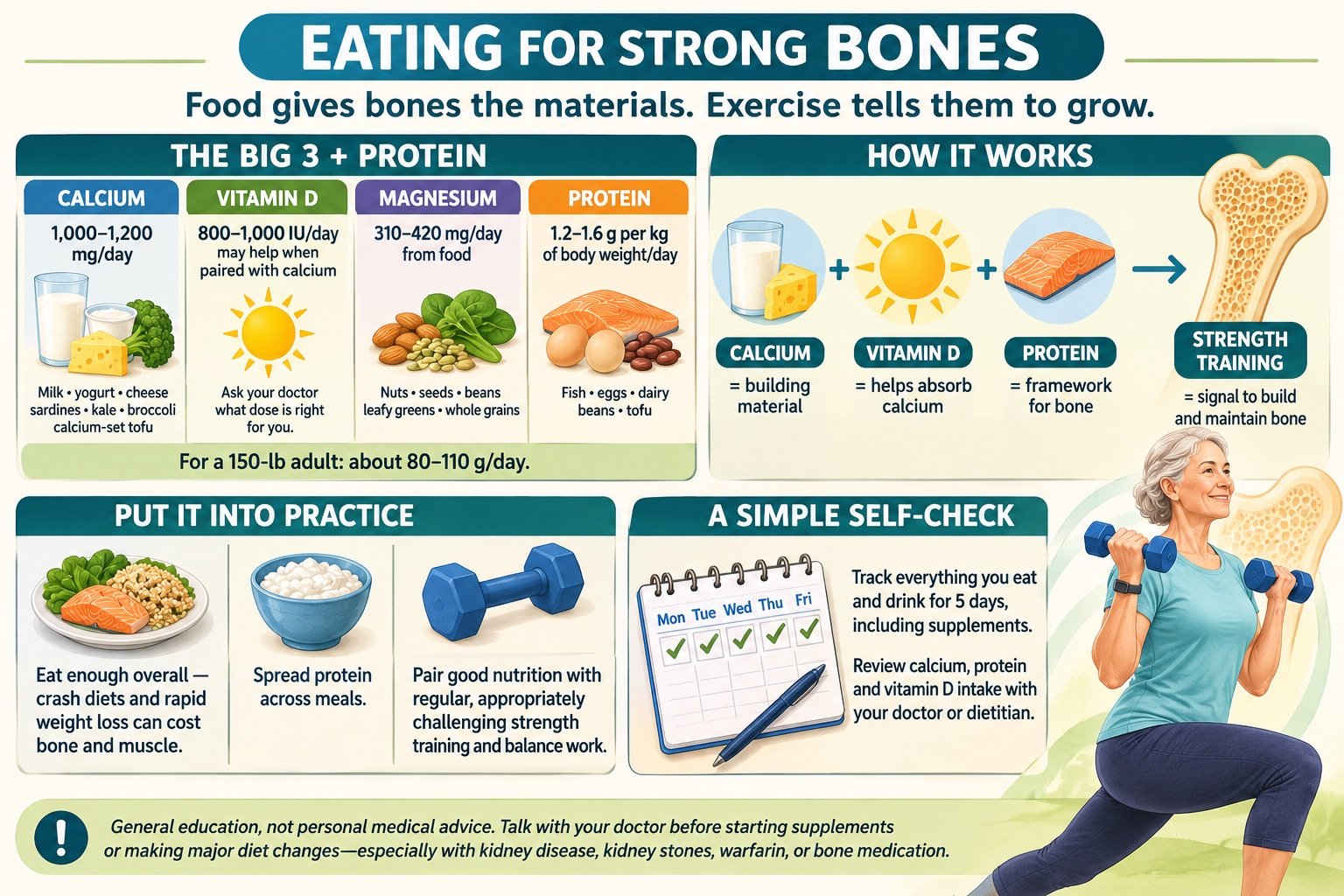
- Aim for 1,000 to 1,200 mg of calcium a day, mostly from food.
- Most adults need 600 IU of vitamin D a day, or 800 IU after age 70. Ask your doctor whether you need more.
- Eat enough protein (about 1.2 to 1.6 grams per kilogram of body weight) and enough calories. Crash diets cost bone.
- Creatine, taken with strength training, may help the hip bone keep its shape. It hasn’t been shown to raise bone density or prevent fractures.
- Food gives bone its materials. Exercise is what tells bone to use them.
- Preventing falls is probably just as important as building bone. About 9 in 10 broken hips in older adults happen in a fall.
Think of bone as a bank account
Your skeleton is your body’s calcium bank. Calcium is the money. Your heart, nerves and muscles need a steady amount of calcium in the blood every minute, and when your diet keeps coming up short, your body makes a withdrawal from bone. Do that day after day for years and the account runs low.
Vitamin D is the teller who lets deposits in. Without it, your gut absorbs much less of the calcium you eat.1 Protein is the vault itself: bone is built on a protein framework (collagen) that the minerals attach to. And exercise is what tells the bank to keep its savings instead of spending them.
The big three: calcium, vitamin D and magnesium
Calcium
Most adults need 1,000 mg a day, and women over 50 and everyone over 70 need 1,200 mg.1 Many people don’t get there: in a national survey from 2017 to early 2020, about half of women over 50 got less than 1,000 mg a day, even counting supplements.2 Food is the best source: milk, yogurt and cheese; canned sardines or salmon with the bones; kale, broccoli and bok choy; and calcium-fortified soy milk, tofu and cereals (check the label).
Spinach is the exception. It has plenty of calcium on paper, but it’s also high in oxalates, natural compounds that lock up calcium so your body can’t absorb it. In one study, people absorbed about 5% of the calcium in spinach, compared with about 28% from milk.3 Rhubarb and beet greens are similar.4 Keep eating them for their other nutrients, but don’t count them toward your calcium.
If you can’t get there with food, a supplement can fill the gap. A few tips:
- Take 500 mg or less at a time. Your body absorbs smaller doses better, so split a larger amount between breakfast and dinner.1
- Don’t overdo it. More isn’t better. Some research suggests calcium supplements may raise the risk of heart problems,1 which is one more reason to get most of yours from food.
- Know the two main types. Most supplements are calcium carbonate or calcium citrate. Carbonate is absorbed better when you take it with a meal, especially if you have low stomach acid (acid-reflux pills lower stomach acid). Citrate depends less on stomach acid, so it can be taken without food.1 Ask your pharmacist which form suits you.
- Ask about your medicines. Calcium can interfere with some medicines, including thyroid pills (levothyroxine) and some antibiotics.1 Your pharmacist can tell you how far apart to take them.
- Keep it apart from bran cereal. 100% wheat bran cereal lowers how much calcium you absorb from other foods eaten with it. In one study, a wheat-bran cereal cut the calcium absorbed from milk by about a third.5 If you eat bran cereal, take your supplement at least two hours before or after it. Whole-wheat bread has much less bran and isn’t a concern.4
Vitamin D
Adults need 600 IU of vitamin D a day through age 70 and 800 IU after that.6 (IU stands for international units, the measure on most labels.) In a large review of 32 trials, people who took 800 to 1,000 IU every day had fewer fractures and falls.7 Two other findings matter just as much:
- Big occasional doses didn’t work. A large dose once a week or once a month did not reduce falls. Daily is better.7
- Vitamin D on its own didn’t prevent fractures. It helped when taken together with calcium, and the benefit was clearest in people over 80 and people living in care homes.8
If a blood test shows you’re low, your doctor may prescribe more for a while. Follow that advice; the numbers above are for everyday use. For healthy adults under 75, the Endocrine Society advises against taking more than the standard daily amount, and for people over 50 it favors a daily dose over big occasional ones.9 If you have osteoporosis, your doctor may want you on a different amount.
Magnesium
Magnesium helps build and maintain bone. Adults need 310 to 420 mg a day in total, and food is the easiest way to get it: nuts, seeds, beans, leafy greens and whole grains.10 If you add a supplement, keep it to 350 mg a day or less unless your doctor advises otherwise. That’s the upper limit the National Institutes of Health sets for magnesium from pills. Whether magnesium pills help prevent or manage osteoporosis isn’t known yet.10
Protein and eating enough
Protein builds the framework that calcium attaches to, and it keeps the muscles that protect you in a fall. A good target for most adults is 1.2 to 1.6 grams of protein per kilogram of body weight a day.1112 For a 150-pound person, that’s about 80 to 110 grams, spread across your meals.
You may have heard that protein “leaches” calcium from bone. That idea has been put to rest.12 In studies that followed adults over 65 for years, those who ate more protein broke fewer hips.13 Studies like these can’t prove protein was the cause, but they point the opposite way from the old worry.
Protein and calcium work as a team. In a study of adults over 65, eating more protein went with better bone density over three years, but only in the people who were also getting plenty of calcium and vitamin D.14
Just as important is eating enough food overall. When the body runs short on energy for a long time, it cuts back on bone building. This is a real risk with crash diets, very restrictive eating, and fast weight loss, including on the newer weight-loss injections. If you are losing weight, protect your bones and muscles with plenty of protein and regular strength training.12 Our free Weight Assessment Tool works out your protein target and a safe pace for weight loss.
Fruits and vegetables round things out. Leafy greens, for example, supply magnesium and vitamin K, two nutrients bone needs.1015
Creatine, paired with strength training
Creatine is a supplement best known for building muscle. It has been tested for bone in women after menopause. In the largest study, 237 women (average age 59) took creatine or a dummy pill for two years while lifting weights three times a week and walking six days a week.16 The results:
- Bone density on a DXA scan (the standard bone density test) was the same in both groups.
- Measures of the shape and bending strength of the hip bone held up better with creatine.
- Women on creatine walked slightly faster.
A different two-year study gave a smaller dose with no exercise program. It found no bone benefit at all.17 So if you try creatine, pair it with strength training. The dose in the larger study was about 0.14 grams per kilogram a day (roughly 9 to 10 grams for a 150-pound person).16 No study has yet shown that creatine prevents fractures. Ask your doctor before starting creatine, especially if you have kidney disease.
Vitamin K
Vitamin K helps a protein in bone hold on to calcium. Leafy greens are a good source.15 So far there isn’t strong proof that vitamin K supplements prevent fractures, and most people who eat a varied diet get enough.12
If you take warfarin (Coumadin), vitamin K changes how the medicine works. Keep your intake of leafy greens steady from week to week, and talk to your doctor before taking any vitamin K supplement.15
What gets in the way
Some habits and medicines make it harder for your body to keep its bone savings:
- Heavy drinking: more than two drinks a day for women, or more than three for men.1218
- Smoking, now or in the past.1219
- Long-term steroid pills such as prednisone.19
- Acid-reflux pills called proton pump inhibitors (for example, omeprazole), which may be linked to fractures with long-term use.19
- Gut conditions that limit how well you absorb nutrients, such as untreated celiac disease.12
- A lot of salt. Your kidneys flush out calcium along with sodium: about 40 mg of calcium for every 2,300 mg of sodium.20 In a two-year study of 124 women past menopause, those who ate more salt lost more bone at the hip.21 Over 70% of the salt we eat comes from packaged and prepared foods, not the salt shaker. On a Nutrition Facts label, 20% of the Daily Value or more for sodium counts as high, and adults should stay under 2,300 mg a day.22
- Cola, possibly. In one large study, women who drank cola every day had slightly lower bone density at the hip. Other sodas showed no link, and it isn’t clear whether cola itself is to blame or it simply takes the place of milk.23
Don’t stop a prescribed medicine on your own. Ask your doctor whether it affects your bones and whether you need extra checks.
Find out what you’re actually eating
Most of us don’t know how much calcium or protein we really eat. Physical therapist Margaret Martin suggests a simple test: record everything you eat and drink for five days in a row, including supplements.24 A free app such as Cronometer will add up your protein, calcium, vitamin D, magnesium and vitamin K, and you can count your fruit and vegetable servings. Five days of real numbers tell you more than any general advice, including this post. Bring the results to your doctor, a dietitian, or us.
Food and exercise work together
Bone gets stronger in response to load, such as challenging strength training, and food supplies the materials it builds with. Good food and the right exercise work best together, alongside any bone medicine your doctor prescribes, not instead of it.
Preventing falls
Stronger bones are only part of the plan. About 9 in 10 broken hips in older adults happen in a fall,25 so avoiding falls is probably just as important as building bone.
The exercise that prevents falls works on balance and on everyday moves like standing up from a chair, stepping and turning. In a review of 108 trials in people over 60, programs like this cut falls by about a quarter, and programs that added strength training probably cut them by about a third. Tai chi may help too.26 Some medicines, vision problems, foot pain and loose rugs also raise the risk.27
Low vitamin B12 is another risk worth checking. B12 keeps your nerves healthy, and when it runs low your feet can feel numb or tingly and your balance can suffer. Many older adults absorb less B12 from food because they make less stomach acid, and acid-reflux pills and the diabetes drug metformin can lower it further. Your doctor can check your level with a blood test.28
We can help here. A physical therapist checks your balance, strength, flexibility and proprioception (your sense of where your body is without looking), finds what’s raising your risk of falling, and builds a program to lower it.
When to talk to your doctor
- Before starting a supplement, if you have kidney disease or a history of kidney stones, take warfarin, or take a bone medicine (some supplements need to be taken at a different time of day)10
- To ask whether a vitamin D or vitamin B12 blood test makes sense for you
- If you’ve lost weight without trying or your appetite has dropped
- If you’ve fallen, or nearly fallen, in the past year
Work with a physical therapist
Food gives your bones the materials. The other half is the right exercise, done safely. A physical therapist can build a strength and balance program around your bones, your bone density results and any past fractures, and help you fit these food changes into your routine.
Sources
- Office of Dietary Supplements, National Institutes of Health. Calcium: Fact Sheet for Consumers and Fact Sheet for Health Professionals.
- US Department of Agriculture, Agricultural Research Service, 2023. Total Usual Nutrient Intake from Food, Beverages, and Dietary Supplements, by Male/Female and Age (Table TA 15, calcium). What We Eat in America, NHANES 2017 to March 2020.
- Heaney et al., 1988. Calcium absorbability from spinach. American Journal of Clinical Nutrition.
- Bone Health & Osteoporosis Foundation. Your guide to a bone healthy diet.
- Weaver et al., 1991. Human calcium absorption from whole-wheat products. Journal of Nutrition.
- Office of Dietary Supplements, National Institutes of Health. Vitamin D: Fact Sheet for Consumers.
- Kong et al., 2022. Effect of vitamin D supplementation on risk of fractures and falls according to dosage and interval: a meta-analysis. Endocrinology and Metabolism.
- Chakhtoura et al., 2022. Vitamin D supplementation and fractures in adults: a systematic umbrella review of meta-analyses of controlled trials. Journal of Clinical Endocrinology & Metabolism.
- Demay et al., 2024. Vitamin D for the prevention of disease: an Endocrine Society clinical practice guideline. Journal of Clinical Endocrinology & Metabolism.
- Office of Dietary Supplements, National Institutes of Health. Magnesium: Fact Sheet for Health Professionals.
- US Department of Agriculture and US Department of Health and Human Services. Dietary Guidelines for Americans, 2025-2030 (protein: 1.2 to 1.6 grams per kilogram of body weight a day).
- Lora Giangregorio (University of Waterloo), interviewed by Simon Hill. Osteoporosis researcher: 3 exercises that actually reduce fracture risk. The Proof (video).
- Groenendijk et al., 2019. High versus low dietary protein intake and bone health in older adults: a systematic review and meta-analysis. Computational and Structural Biotechnology Journal.
- Dawson-Hughes and Harris, 2002. Calcium intake influences the association of protein intake with rates of bone loss in elderly men and women. American Journal of Clinical Nutrition.
- Office of Dietary Supplements, National Institutes of Health. Vitamin K: Fact Sheet for Health Professionals.
- Chilibeck et al., 2023. A 2-yr randomized controlled trial on creatine supplementation during exercise for postmenopausal bone health. Medicine & Science in Sports & Exercise.
- Sales et al., 2020. Creatine supplementation (3 g/d) and bone health in older women: a 2-year, randomized, placebo-controlled trial. Journals of Gerontology, Series A.
- LeBoff et al., 2022. The clinician’s guide to prevention and treatment of osteoporosis. Osteoporosis International.
- Peter Attia. Navigating bone health: early life influences & strategies for improvement & injury prevention. The Drive podcast, 2022 (video).
- Nordin et al., 1993. The nature and significance of the relationship between urinary sodium and urinary calcium in women. Journal of Nutrition.
- Devine et al., 1995. A longitudinal study of the effect of sodium and calcium intakes on regional bone density in postmenopausal women. American Journal of Clinical Nutrition.
- US Food and Drug Administration. Sodium in Your Diet.
- Tucker et al., 2006. Colas, but not other carbonated beverages, are associated with low bone mineral density in older women: the Framingham Osteoporosis Study. American Journal of Clinical Nutrition.
- Margaret Martin. What to do after being diagnosed with osteoporosis. MelioGuide, 2025.
- Moreland et al., 2023. Hip fracture-related emergency department visits, hospitalizations and deaths by mechanism of injury among adults aged 65 and older, United States 2019. Journal of Aging and Health.
- Sherrington et al., 2019. Exercise for preventing falls in older people living in the community. Cochrane Database of Systematic Reviews.
- Centers for Disease Control and Prevention. Facts About Older Adult Falls.
- Office of Dietary Supplements, National Institutes of Health. Vitamin B12: Fact Sheet for Consumers.