Why this matters now
Hearing “your cholesterol is high” can feel like bad news. Think of it as early news. Plaque in the arteries builds slowly, over decades. LDL cholesterol causes that buildup, and the longer your LDL stays low, the lower your risk.1 Changes you make this year have plenty of time to pay off.
What high cholesterol actually means
Cholesterol is a waxy fat your body needs and mostly makes on its own. Fat and blood don’t mix, so your liver packs cholesterol into tiny particles that travel through your bloodstream like delivery trucks.
The trucks that matter most for your heart are LDL particles, the “bad cholesterol.” Each one carries a single protein tag called apoB (apolipoprotein B). The two blood tests measure different things:
- LDL cholesterol (LDL-C), the number on a standard blood test, measures how much cargo the trucks carry.
- ApoB counts the trucks themselves.
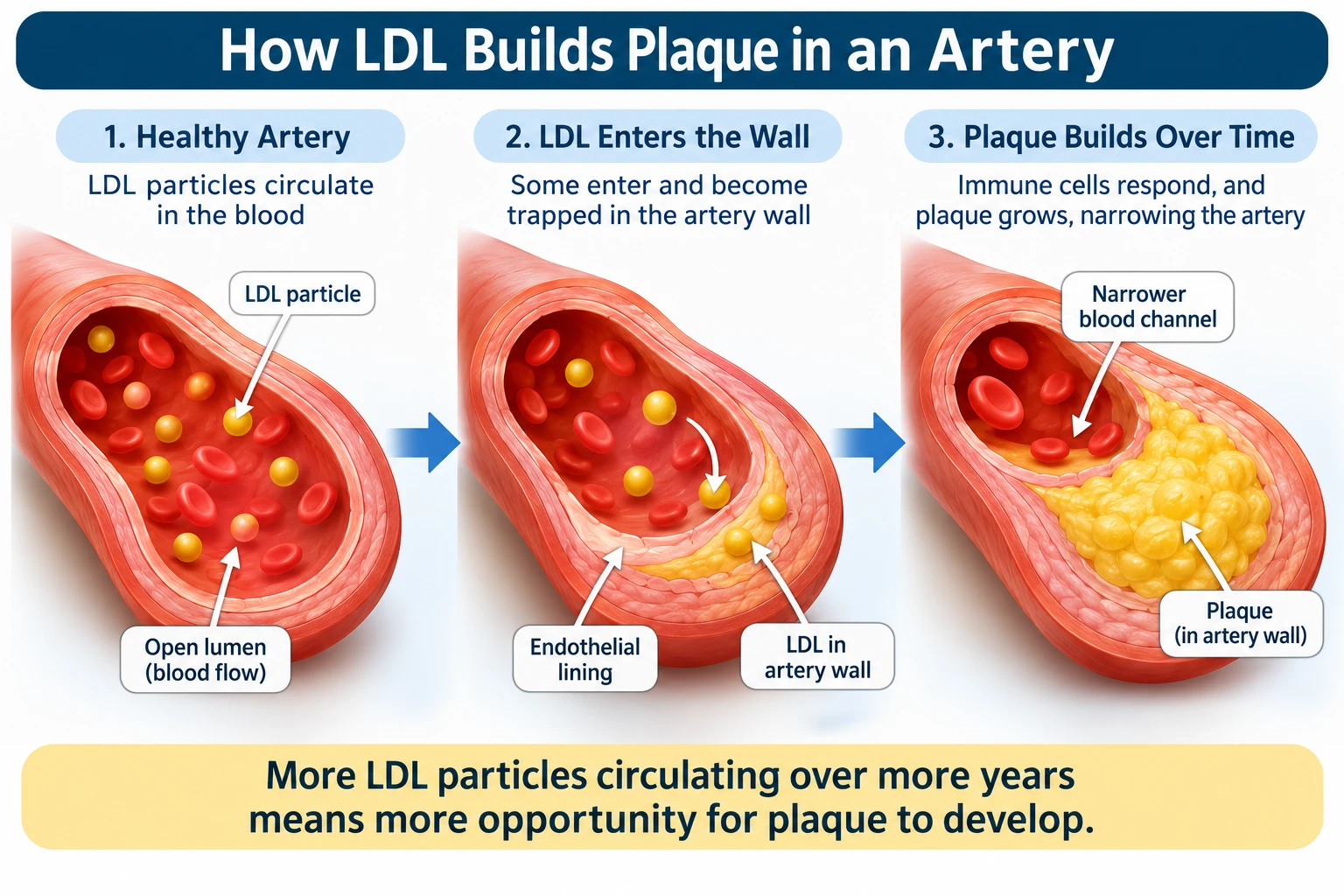
Plaque starts when trucks slip through the inner lining of an artery and get stuck in the wall. Over years, the stuck particles attract immune cells and build into plaque, the fatty buildup that narrows arteries and can lead to a heart attack or stroke. Fewer trucks on the road, for more of your life, means less plaque.
Know your numbers
A standard cholesterol panel is a good start. Two more tests are worth asking about:
- ApoB counts the trucks directly. Many lipid specialists prefer it to LDL-C alone.
- Lp(a) (say “L-P-little-a”) is a type of particle set mostly by your genes. The European Atherosclerosis Society recommends that every adult have it checked at least once.3 If yours is high, your doctor will want to manage your other risks more closely.
Your doctor will also give you a goal. Since 2026, US guidelines set LDL goals by risk group:4
Your doctor works out your risk group with a calculator called PREVENT and may use a calcium scan to fine-tune it. Lab “normal” ranges describe the average person, and heart disease is common, so ask which goal fits you.
A coronary calcium scan (a “CAC” score) looks for hardened, calcified plaque. A score of zero is reassuring, but the scan can’t see soft plaque. In a review of 14 studies, about 1 in 10 people with a zero score had some soft plaque on a more detailed scan.5 If your doctor suggests a scan, ask what it can and can’t show.
What about “good” cholesterol?
You may have heard that a high HDL, the “good cholesterol,” or a good HDL-to-LDL ratio balances out a high LDL. It doesn’t. People with high HDL do tend to have fewer heart attacks, but HDL looks more like a sign of good health than a cause of it. People born with genes that raise their HDL don’t have fewer heart attacks, while genes that raise LDL clearly add risk.6 Medicines that raise HDL haven’t helped either. In a trial of more than 25,000 people with heart disease, niacin raised HDL but didn’t prevent heart attacks or strokes, and it caused more serious side effects.7 Higher isn’t always better: in a Danish study of more than 116,000 adults, people with extremely high HDL (above about 116 mg/dL in men and 135 in women) had a higher risk of dying than people with moderately high HDL.8
The ratio still has a use. In a pooled analysis of 61 studies, total cholesterol divided by HDL predicted heart disease deaths better than total cholesterol alone.9 Predicting risk is one thing, though, and lowering it is another. LDL and apoB are the numbers to bring down.
Food changes that lower LDL
Food can lower LDL a lot. In a one-month trial, a “portfolio” of cholesterol-lowering foods cut LDL by 28.6%, close to the 30.9% drop in a group taking a statin (a cholesterol-lowering medicine).10 When people cooked for themselves at home, the drop was smaller, about 13% over six months.11 A review of seven trials puts the average at about 17% and rates the evidence as high quality.12
The Portfolio Diet adds four kinds of food. The research team uses these daily amounts for a 2,000-calorie diet:13
- Nuts and seeds, about 45 g, or roughly two small handfuls.
- Plant protein, about 50 g, from tofu, soy milk, beans, chickpeas and lentils.
- Sticky (viscous) fiber, about 20 g, from oats, barley, psyllium, eggplant, okra, apples and oranges. This fiber traps bile in your gut. Bile is made from cholesterol, so your liver pulls more cholesterol out of your blood to replace it.
- Plant sterols, about 2 g, from fortified foods or supplements. At that dose they lower LDL by about 8 to 10%. No trial has yet tested whether they prevent heart attacks, so ask your doctor before adding a supplement.14
Each one lowers LDL a little, and the big drops in the trials came from eating them together. You can add them one at a time.
Saturated fat, found in fatty red meat, butter, cream, cheese and coconut oil, raises LDL. Coconut oil has a healthy reputation, but in a review of 16 trials it raised LDL by about 10 mg/dL compared with other vegetable oils.15 Olive, canola and soybean oil are better choices. A Harvard study followed more than 220,000 adults for up to 33 years. The people who ate the most butter had a 15% higher risk of dying during the study, and those who ate the most plant oils had a 16% lower risk.16
Eggs and other foods that contain cholesterol raise LDL too, but only modestly. In a review of 55 trials, each extra 100 mg of dietary cholesterol a day raised LDL by about 2 to 5 mg/dL.17 People respond differently, and some people absorb more cholesterol from food than others,18 so recheck your numbers after you make changes.
Movement, blood pressure and the rest
The American Heart Association’s “Life’s Essential 8” lists what protects your heart: a healthy diet, physical activity, no nicotine, good sleep, a healthy weight, and healthy cholesterol, blood sugar and blood pressure.19
Blood pressure responds well to everyday habits. In the DASH-Sodium trial, a diet rich in fruits, vegetables and low-fat dairy, combined with less salt, lowered systolic blood pressure (the top number) by about 11.5 points in people with high blood pressure.20 In a separate review, regular endurance exercise lowered it by about 8 points in people with high blood pressure.21 Losing extra weight helps too. In a review of 25 trials, each kilogram (about 2.2 pounds) lost lowered systolic blood pressure by about 1 point, so losing 5 kg (about 11 pounds) lowered it by about 4 to 5 points.22
Exercise is one of the best things you can do for your heart, blood pressure and blood sugar, but its effect on LDL is small. In a review of 48 trial groups, aerobic training lowered LDL by about 5 to 8 mg/dL.23 Food and, when needed, medicine do most of that work. If joint pain, a past injury or low fitness makes exercise hard, that’s where we come in. We’ll build a plan around how you move today and set how much and how often with you after an assessment.
If your doctor suggests medicine
Diet and medicine add together. In the DISCO-CT trial, people with early plaque took cholesterol medicine and also followed the DASH diet with a dietitian’s support. Their soft plaque shrank more than twice as much as it did in people on medicine alone.24
- Statins are among the most studied medicines in the world. One analysis pooled 23 large trials with about 155,000 people.25 Other options include ezetimibe, which blocks cholesterol absorption in the gut, bempedoic acid and PCSK9 inhibitors. Your doctor will talk through which, if any, fits you.
- In the large trials, people on a statin reported muscle aches only slightly more often than people on a placebo. In the first year, about 1 in 15 of those reports was actually caused by the statin.25 If you notice new aches after starting a cholesterol medicine, talk to your doctor before stopping it.
Questions to bring to your doctor
- What’s my apoB? Can we add it to my next blood test?
- Have I had Lp(a) checked?
- Given my family history and other risks, what target is right for me?
- Would a scan help? What can it show, and what can’t it?
- How much could diet changes do for me, and when should we recheck?
- If medicine makes sense, what are my options, and which side effects should I report?
The bottom line
- Ask for your LDL and apoB, and get Lp(a) checked at least once.
- Add nuts, plant protein and sticky fiber before worrying about what to cut.
- Cook with olive or canola oil instead of butter or coconut oil.
- Keep moving, and keep an eye on your blood pressure.
- If you need medicine, it works alongside your habits. Needing it doesn’t mean they failed.
- Recheck with your doctor and adjust. Lower for longer is the goal.
Work with a physical therapist
Heart-healthy exercise works best when it fits your body. We check how you move, how strong you are and what your joints will tolerate, then build a plan you can keep up. Many people on a statin wonder whether new muscle soreness comes from the medicine or from being more active. We can help sort that out and work with your doctor. We’re here to help you stay active and healthy for the long run. Book an assessment with our team, and we’ll build a heart-healthy routine around you.
Sources
- Ference BA et al., 2017. Low-density lipoproteins cause atherosclerotic cardiovascular disease. 1. Evidence from genetic, epidemiologic, and clinical studies. A consensus statement from the European Atherosclerosis Society Consensus Panel. Eur Heart J.
- Soto-Mota A et al., 2025. Longitudinal data from the KETO-CTA study: plaque predicts plaque, ApoB does not. JACC Adv. RETRACTED March 2026 (journal notice: “the identified errors are too great to be corrected with a corrigendum”). Retraction Watch report.
- Kronenberg F et al., 2022. Lipoprotein(a) in atherosclerotic cardiovascular disease and aortic stenosis: a European Atherosclerosis Society consensus statement. Eur Heart J.
- Blumenthal RS et al., 2026. 2026 ACC/AHA/AACVPR/ABC/ACPM/ADA/AGS/APhA/ASPC/NLA/PCNA guideline on the management of dyslipidemia. J Am Coll Cardiol. Summary from the American College of Cardiology.
- Sama C et al., 2024. Non-calcified plaque in asymptomatic patients with zero coronary artery calcium score: a systematic review and meta-analysis. J Cardiovasc Comput Tomogr.
- Voight BF et al., 2012. Plasma HDL cholesterol and risk of myocardial infarction: a mendelian randomisation study. Lancet.
- HPS2-THRIVE Collaborative Group, 2014. Effects of extended-release niacin with laropiprant in high-risk patients. N Engl J Med.
- Madsen CM et al., 2017. Extreme high high-density lipoprotein cholesterol is paradoxically associated with high mortality in men and women: two prospective cohort studies. Eur Heart J.
- Prospective Studies Collaboration, 2007. Blood cholesterol and vascular mortality by age, sex, and blood pressure: a meta-analysis of individual data from 61 prospective studies with 55,000 vascular deaths. Lancet.
- Jenkins DJ et al., 2003. Effects of a dietary portfolio of cholesterol-lowering foods vs lovastatin on serum lipids and C-reactive protein. JAMA.
- Jenkins DJ et al., 2011. Effect of a dietary portfolio of cholesterol-lowering foods given at 2 levels of intensity of dietary advice on serum lipids in hyperlipidemia: a randomized controlled trial. JAMA.
- Chiavaroli L et al., 2018. Portfolio dietary pattern and cardiovascular disease: a systematic review and meta-analysis of controlled trials. Prog Cardiovasc Dis.
- Kavanagh ME et al., 2024. The Portfolio Diet and HbA1c in adults living with type 2 diabetes mellitus: a patient-level pooled analysis of two randomized dietary trials. Nutrients.
- Gylling H et al., 2014. Plant sterols and plant stanols in the management of dyslipidaemia and prevention of cardiovascular disease. Atherosclerosis.
- Neelakantan N et al., 2020. The effect of coconut oil consumption on cardiovascular risk factors: a systematic review and meta-analysis of clinical trials. Circulation.
- Zhang Y et al., 2025. Butter and plant-based oils intake and mortality. JAMA Intern Med.
- Vincent MJ et al., 2019. Meta-regression analysis of the effects of dietary cholesterol intake on LDL and HDL cholesterol. Am J Clin Nutr.
- Öörni K et al., 2026. High cholesterol absorption efficiency enhances proatherogenic properties of low-density lipoprotein particles. J Intern Med.
- Lloyd-Jones DM et al., 2022. Life's Essential 8: updating and enhancing the American Heart Association's construct of cardiovascular health. Circulation.
- Sacks FM et al., 2001. Effects on blood pressure of reduced dietary sodium and the Dietary Approaches to Stop Hypertension (DASH) diet. N Engl J Med.
- Cornelissen VA, Smart NA, 2013. Exercise training for blood pressure: a systematic review and meta-analysis. J Am Heart Assoc.
- Neter JE et al., 2003. Influence of weight reduction on blood pressure: a meta-analysis of randomized controlled trials. Hypertension.
- Wood G et al., 2021. Determining the effect size of aerobic exercise training on the standard lipid profile in sedentary adults with three or more metabolic syndrome factors: a systematic review and meta-analysis of randomised controlled trials. Br J Sports Med.
- Henzel J et al., 2021. High-risk coronary plaque regression after intensive lifestyle intervention in nonobstructive coronary disease: a randomized study. JACC Cardiovasc Imaging.
- Cholesterol Treatment Trialists' Collaboration, 2022. Effect of statin therapy on muscle symptoms: an individual participant data meta-analysis of large-scale, randomised, double-blind trials. Lancet.